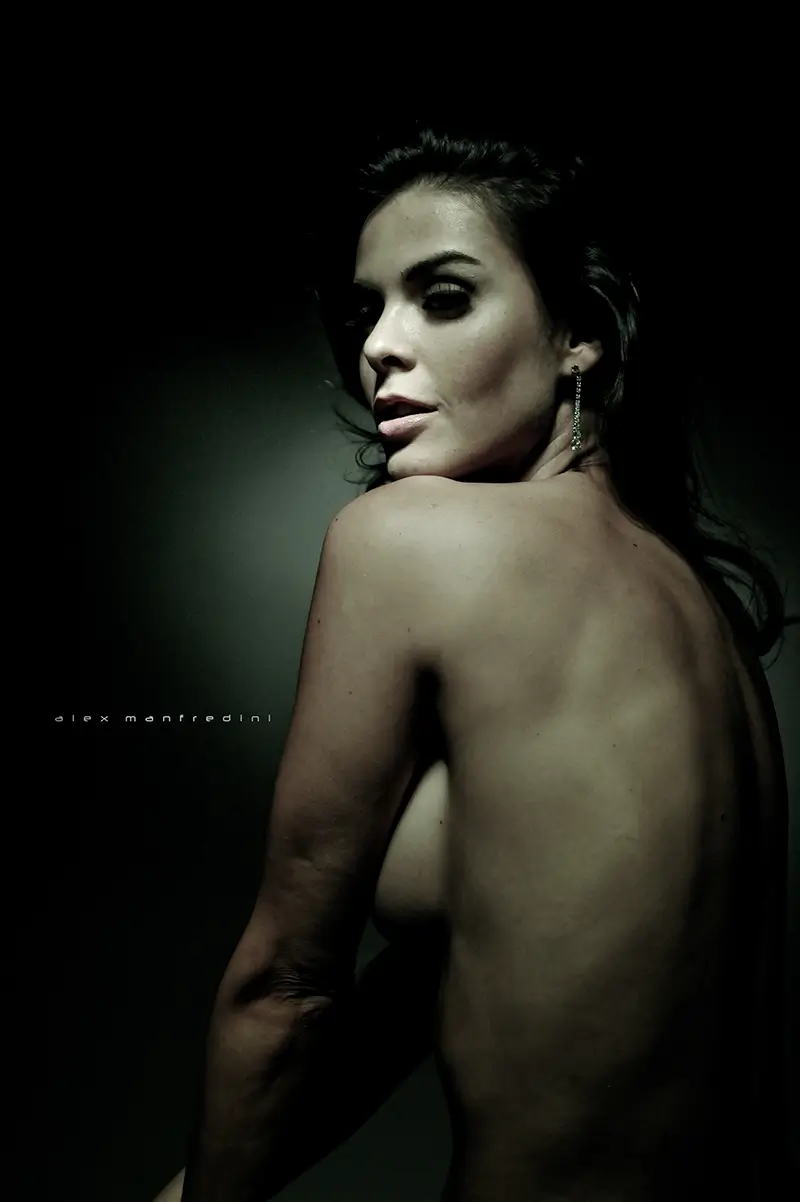

Sometimes what a photograph refuses to show is exactly what makes it impossible to forget.
There is a peculiar obsession in erotic photography with showing just enough.
A shoulder slipping out of a dress. A hand resting somewhere interesting. A bedsheet positioned with the mathematical precision of a tax accountant trying to stay within the rules.
Apparently, this is what we’re supposed to call the art of suggestion.
Sometimes it is.
Sometimes it’s just a photograph asking you to imagine the next photograph.
I’ve made both kinds. After more than thirty years behind a camera, I can tell you that the difference has very little to do with how much skin is showing.
And everything to do with what happens in your mind after you’ve looked away.
The Difference Between Hiding and Suggesting
Covering something doesn’t automatically make it mysterious.
A woman standing behind a curtain isn’t necessarily more sensual than a woman standing in front of it. Sometimes she’s simply harder to see.
The same applies to shadows, strategically placed hands, and those wonderfully convenient bedsheets.
If all I’ve accomplished is making you wonder what’s underneath, I haven’t necessarily created an interesting photograph.
I’ve created curiosity.
There’s nothing wrong with curiosity. It’s kept a few industries in business for centuries.
But genuine suggestion does something more complicated.
It gives you enough information to feel that something has happened, or is about to happen, without allowing you to witness the entire story.
A hand slowly withdrawing from someone’s shoulder.
A glance that lasts a fraction of a second longer than politeness requires.
The expression on someone’s face after a conversation we will never hear.
Nothing particularly explicit.
Yet somehow, you know there’s a story.
And you want to know more.
What Happens Outside the Frame
One of the most interesting things about photography is that the camera records only a fraction of what is happening.
The rest disappears.
The person standing just outside the frame. The words spoken a moment earlier. The reason someone suddenly stopped smiling.
As a photographer, I know those things. I was there.
But the viewer wasn’t.
That’s where suggestion becomes an interesting challenge.
If a photograph needs me standing beside it explaining what happened before I pressed the shutter, perhaps I didn’t tell the story very well.
I’ve made photographs that felt extraordinary while I was taking them, only to discover later that the magic existed mostly in my memory.
The picture was beautiful.
The experience had been beautiful.
Unfortunately, they weren’t quite the same thing.
A photograph cannot borrow emotions from a moment the viewer never experienced. It has to create its own.
And sometimes the smallest detail does more work than the most elaborate pose.
The Moment Before. The Moment After.
I’ve always been fascinated by the moments surrounding an action.
Not necessarily the action itself.
Consider a kiss.
The kiss is easy to understand. Two people, lips touching. The camera records what happened.
But the moment just before?
The hesitation. The distance narrowing. The possibility that one of them might change their mind.
Or the moment afterward, when they separate but haven’t quite returned to being two independent people.
Those moments can carry an extraordinary amount of emotion.
Not because they conceal the kiss.
Because they reveal something about the people.
Desire isn’t always most interesting at its destination. Sometimes the journey is where everything happens.
And sometimes the most revealing photograph is the one taken when nobody thinks the important moment is happening anymore.
The Story We Bring With Us
There’s another complication.
Every person who looks at a photograph brings their own experiences, memories, desires, and prejudices.
I can guide what you see. I cannot completely control what you feel.
A gesture that seems tender to one person might feel distant to another. A shadow that creates intimacy for someone might create discomfort for someone else.
That’s not necessarily a failure.
Art doesn’t require every viewer to arrive at exactly the same conclusion.
But I do believe a photograph should give them something worth interpreting.
Otherwise, we’re not really talking about suggestion.
We’re talking about an empty space into which everyone pours whatever they brought with them.
And while that can be entertaining, it doesn’t automatically make the photographer particularly clever.
The Person Inside the Photograph
There is one part of this conversation I consider more important than all the clever compositions and dramatic lighting in the world.
The person being photographed.
When I direct someone, I’m not simply arranging a body to produce an effect.
I’m asking a person to participate in an interpretation of themselves.
That’s a responsibility.
I can make a gesture appear tender, provocative, vulnerable, dominant, hesitant, or inviting through a small change in timing, expression, or context.
But if the story I’m constructing has nothing to do with what that person agreed to express, I’ve crossed a line.
A photograph can be visually brilliant and still misrepresent the person inside it.
I don’t find that particularly artistic.
I find it convenient.
The strongest photographs I’ve made were not the ones in which I imposed the most elaborate fantasy.
They were the ones in which the person in front of my camera recognized something of themselves in what we created together.
Something perhaps unfamiliar.
But not false.
What Remains
We live in a world that has become extraordinarily efficient at showing us everything.
Every angle. Every detail. Every possible variation of the same idea.
And then another one, just in case we missed something.
There is certainly a place for explicit imagery. I’ve spent enough of my life creating it to pretend otherwise.
But I don’t believe showing more necessarily communicates more.
Nor do I believe hiding more automatically makes an image sophisticated.
The question is simpler.
What stays with you?
The photograph that answered every question before you could ask it?
Or the one that left you thinking about a gesture, an expression, a moment you almost understood?
I don’t want the viewer to finish my photographs for me.
I want to give them something they can’t quite finish thinking about.
That’s where suggestion begins.