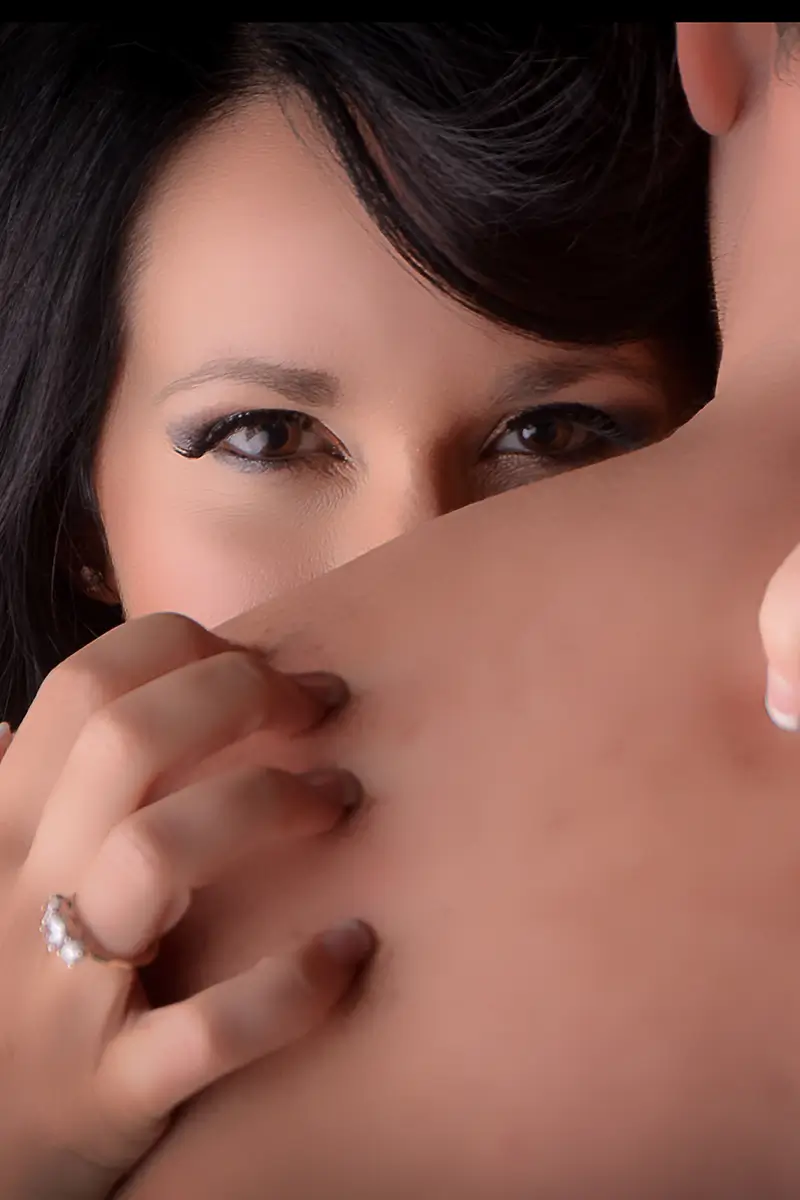

“We don’t become ourselves when nobody is watching. We become ourselves when we trust who’s watching.”
People tell me they want to discover who they are when nobody is watching.
Then they hire a man with a camera.
I’ve always appreciated the contradiction.
After more than thirty years photographing people in their most private moments, I’ve learned something that doesn’t fit particularly well into the usual inspirational speeches about self-discovery.
We don’t necessarily become our true selves when nobody is watching. We become different versions of ourselves depending on who’s allowed to watch.
And sometimes, those versions surprise everyone in the room.
The Audience We Choose
Most of us spend our lives performing for an audience we never consciously selected.
Family. Friends. Colleagues. Neighbors. The people who think they know us because they’ve seen us behave consistently for twenty years.
We learn the choreography early. What to say, what not to reveal, when to laugh, how much desire is socially acceptable before someone starts questioning our character.
Eventually, we become so good at playing our roles that we mistake familiarity for identity.
Then someone books a private photography session.
Suddenly, the audience changes.
The office isn’t watching. The neighbors aren’t watching. The children aren’t watching. There’s just a photographer, perhaps a partner, and a door that closes.
And something interesting happens.
Not necessarily liberation. Sometimes confusion.
Because removing an audience doesn’t automatically remove the performance.
When Two People Stop Performing
Couples have taught me more about human nature than almost anyone else.
They often arrive with a shared idea of what the session will be. Romantic. Playful. Adventurous. Perhaps an opportunity to reconnect.
And for the first twenty minutes, they perform that idea beautifully.
They know how to stand together. They know which expressions belong to their relationship. They know how they’re supposed to look at each other.
Then something interrupts the choreography.
A strap refuses to cooperate. Someone laughs at an inappropriate moment. One partner suddenly looks at the other, not for the camera, but to ask a question without speaking.
Are we still comfortable with this?
That’s when I become interested.
Not because I’ve discovered their secret marriage or uncovered some hidden psychological truth. I’m a photographer, not a marriage counselor.
But because, for a moment, the performance has a different audience.
That look isn’t intended for me.
It belongs to the two people sharing the room.
And sometimes one of them sees something in the other that wasn’t part of the original plan.
It might be vulnerability. Confidence. Hesitation. Desire.
I don’t pretend to know what it means for their relationship.
I just know that the most revealing moments aren’t always the ones people came prepared to reveal.
The Curious Discipline of Desire
People outside the Lifestyle often imagine that sexual freedom means abandoning rules.
My experience suggests something considerably more interesting.
Among couples and individuals who consciously explore their desires, I’ve frequently observed the opposite.
They communicate. They establish boundaries. They check with one another. They understand that consent isn’t an inconvenience interrupting desire.
It’s what makes desire possible without turning trust into a casualty.
Of course, these communities have their own expectations, insecurities, and social performances. Human beings don’t suddenly become enlightened because they attend a different kind of party.
But there’s something worth recognizing.
Sometimes the people society considers unconventional are simply more deliberate about negotiating the rules everyone else pretends don’t exist.
Freedom isn’t always the absence of boundaries.
Sometimes it’s having the privilege of choosing them.
The Myth of the Real You
There’s a popular story about intimate photography that I’ve never entirely believed.
A woman enters the studio wearing the expectations of her everyday life. A few hours later, she leaves having discovered the woman she was always meant to be.
Beautiful story.
Wonderful marketing.
A little too convenient.
I’ve photographed confident professionals who became unexpectedly shy in front of my camera. I’ve photographed reserved people who seemed perfectly comfortable exploring a side of themselves their colleagues would never recognize.
Neither reaction made one version more authentic than the other.
The professional wasn’t wearing a false identity at work. The reserved woman wasn’t secretly waiting to become someone else.
They were the same people under different circumstances.
We contain contradictions. We adapt. We experiment. We sometimes enjoy being someone we have no intention of becoming permanently.
And that’s perfectly fine.
Not every private experience needs to become a public declaration of identity.
Sometimes an afternoon is simply an afternoon.
A memorable one, hopefully.
The Privilege of Being Trusted
There’s one thing I take very seriously about the work I do.
People aren’t merely trusting me to make them look attractive.
They’re trusting me with a version of themselves that may belong to a very small circle, or perhaps only to that particular moment.
That’s why privacy isn’t a marketing accessory. It’s part of the experience itself.
The photographs are theirs. The decision about who sees them is theirs. The boundaries are theirs.
My responsibility is to create the conditions in which they can explore without feeling that the experience will later be used against them.
I don’t need to declare that I’ve discovered someone’s true identity.
I haven’t.
I’ve simply been invited to witness something they chose to share.
And after thirty years, I still consider that an extraordinary privilege.
Who’s Watching?
So, who are we when nobody is watching?
I suspect the question itself is wrong.
I’ve never met a person entirely free of the influence of an audience, even when that audience exists only in their imagination.
What I have met are people who behave differently when they trust the person watching.
Sometimes they’re bolder. Sometimes they’re quieter. Sometimes they’re surprisingly uncertain.
And sometimes, for one fleeting moment, they stop worrying about how they’re supposed to appear.
That’s usually when I press the shutter.
We don’t become ourselves when nobody is watching. We become ourselves when we trust who’s watching.
And perhaps the most interesting thing about human nature is that there was never just one version of us to begin with.